
Every successful electronic product begins as a Prototype—a handmade proof-of-concept that validates the design concept and demonstrates feasibility. The journey from that first working Prototype to mass production capable of serving thousands or millions of customers represents one of the most challenging transitions in hardware development. Prototypes that function perfectly in the lab often fail catastrophically when manufacturing scales, supply chains extend, and real-world conditions replace controlled environments.
The scaling transition isn't merely about building more boards. It requires fundamental rethinking of design decisions made for prototyping convenience, manufacturing processes optimized for low volume, and supply chains that assumed immediate component availability. Teams that navigate this transition successfully emerge with products that maintain prototype performance at production scale. Teams that fail discover that the gap between "works in the lab" and "ships to customers" is far wider than they anticipated.
This article explores the systematic approaches that enable smooth scaling from Custom Pcb prototypes to mass production—design practices, manufacturing transitions, and Supply Chain strategies that transform promising prototypes into reliable products.
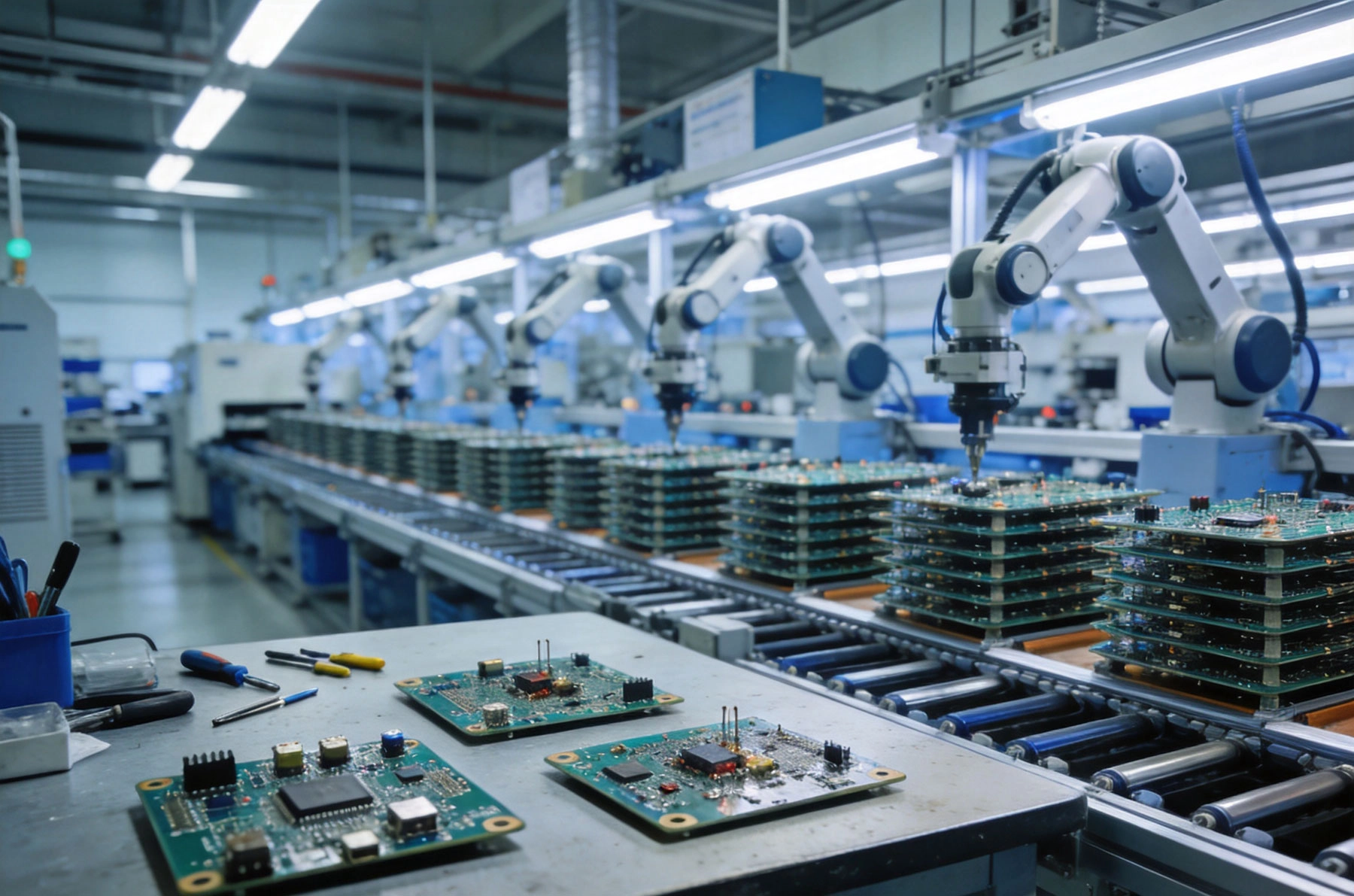
The transition from prototype to mass production involves more than increasing quantities. Several fundamental differences separate prototype and production environments that affect every aspect of the product.
Manufacturing Process Differences
Prototypes are typically built using processes optimized for flexibility rather than efficiency. Hand soldering, manual component placement, and rework-friendly designs accommodate the iteration and experimentation that prototyping requires. Mass production demands processes optimized for speed, consistency, and Automation—requirements that may conflict with prototyping approaches.
A component hand-soldered by an experienced technician during prototyping might be problematic for automated assembly. A test point accessible for debugging might interfere with automated testing equipment. A jumper wire that solved a Signal Integrity problem in the prototype might be impossible to implement reliably at production scale. Each prototyping convenience becomes a production liability that must be engineered out.
Component Availability Reality
Prototype builds often use components from immediate stock—distributor inventory, engineer desk drawers, or samples from component manufacturers. Mass production requires supply chains that can reliably deliver components in volume over extended periods. Components readily available for prototype quantities may have lead times of months or may be approaching end-of-life when production scales.
The component that seemed perfect during prototyping because it was immediately available from local stock might prove unavailable for production volumes. The specialized sensor that worked beautifully might have a single supplier with capacity constraints. The memory chip that solved your storage problem might be scheduled for discontinuation within your production timeframe.
Environmental Variation
Prototypes operate in controlled environments—stable temperatures, clean benches, careful handling by people who understand the product intimately. Production units face the full variation of real-world deployment—temperature extremes, humidity, vibration, and handling by people with no product knowledge. Design margins adequate for controlled prototyping often prove insufficient for real-world conditions.
Thermal Management designed for air-conditioned labs may fail in outdoor installations. Signal Integrity margins that worked on the bench may fail with longer cable runs in field installations. Mechanical tolerances acceptable for prototype assembly may cause fit problems when manufacturing variation accumulates across thousands of units.
Design For Manufacturing (Dfm) represents the systematic practice of designing products that can be manufactured efficiently at production volumes. Applying Dfm principles during the prototype phase prevents the expensive redesign that otherwise occurs when scaling attempts reveal manufacturability problems.
Component Package Selection
Prototype designs sometimes use component packages selected for ease of hand assembly—large through-hole parts, generous SMT packages with visible leads, components that can be easily reworked. Mass production benefits from smaller, more automated-friendly packages that maximize board density and minimize assembly time.
Transition planning should evaluate whether prototype component selections remain appropriate for production. A through-hole connector that simplified prototype assembly might be replaced by a surface-mount equivalent for production. A large discrete component might be replaced by a smaller alternative that automated placement handles more efficiently. These transitions must be validated through testing before production commitment.
Panelization Strategy
Individual prototype boards are manufactured as single units. Mass production requires panelization—arranging multiple boards in an array that manufacturing processes can handle efficiently. Panelization decisions affect assembly efficiency, testing accessibility, and depaneling stress on components.
Effective panelization considers board orientation for component placement, test point accessibility, V-score or tab routing requirements, and handling features that enable automated processing. Panel design should be finalized during prototype-to-production transition, with prototypes built on representative panels when possible to validate panelization assumptions.
Test Point Provision
Prototypes benefit from extensive test points that enable debugging and characterization. Production units need test points optimized for manufacturing test rather than engineering debug—accessible to automated test equipment, positioned away from tall components, and limited to signals essential for production verification.
The transition should rationalize test point provision, removing debug-only points that add no production value while ensuring that production test requirements are fully covered. In-circuit test (Ict) fixture design should proceed in parallel with board design to ensure test point accessibility.
The manufacturing partner for prototypes may be entirely unsuitable for mass production. Prototype shops specialize in quick turnaround, design flexibility, and low-volume handling. Mass production requires partners optimized for throughput, consistency, and process control. Selecting and qualifying the right manufacturing partner is critical to scaling success.
Capability Assessment
Evaluate potential manufacturing partners against the specific requirements your product presents. SMT placement accuracy and speed, component handling capabilities, testing equipment, and quality systems should all be assessed against your product's needs. A partner capable of building your prototype may lack the equipment or processes for efficient mass production.
Request process capability data demonstrating that the partner can achieve your tolerances consistently. Review quality systems and certifications relevant to your market—ISO 9001 for general quality, Iatf 16949 for automotive, Iso 13485 for medical. Tour facilities to observe actual operations rather than relying on marketing materials.
Production Ramp Planning
Mass production rarely begins at full volume immediately. Most products ramp production gradually—pilot runs validate processes, initial production builds work out remaining issues, and volume increases as confidence builds. Planning this ramp with your manufacturing partner prevents the capacity constraints and quality problems that abrupt volume increases can cause.
Discuss capacity availability and expansion plans with potential partners. Understand their equipment utilization, staffing plans, and ability to accommodate your volume growth. Partners who cannot scale with your success become constraints that limit your growth.
Communication and Relationship
Mass production relationships require sustained communication that prototyping relationships may not. Regular production reviews, quality performance discussions, and collaborative problem-solving characterize successful long-term manufacturing partnerships. Evaluate potential partners on their communication practices and relationship approach, not just technical capabilities.
Cultural fit matters, particularly for international manufacturing relationships. Partners who understand your expectations, communicate proactively, and respond effectively to problems reduce the friction that manufacturing relationships can generate.
Supply chains for prototypes and mass production operate at fundamentally different scales. Transitioning from prototype Component Procurement to production supply chains requires careful planning and execution.
Component Qualification and Second Sourcing
Prototype components should be evaluated for production suitability before committing to mass production. Qualification testing validates that components meet specifications under expected operating conditions. Second-source identification ensures supply continuity when primary sources face constraints.
Components should be qualified through the full range of expected operating conditions—temperature, voltage, and load variations that exceed nominal specifications. Long-term reliability testing may be appropriate for critical components or extended warranty products. Document qualification results to support future component decisions.
Inventory Strategy Development
Prototype Component Procurement assumes immediate availability—order today, receive tomorrow. Mass production requires inventory strategies that balance availability against carrying cost and obsolescence risk. Safety stock levels, reorder points, and supplier-managed inventory arrangements all require definition.
Component lead times drive inventory requirements. Components with extended lead times require either larger safety stocks or advance ordering that commits capital before production needs materialize. Understanding and planning for lead times prevents production interruptions from component unavailability.
Supplier Relationship Development
Prototype component purchasing is typically transactional—place orders with whichever distributor has stock. Mass production benefits from developed supplier relationships that provide priority treatment, volume pricing, and collaborative problem-solving when supply problems arise.
Invest in relationships with key component suppliers. Share volume forecasts, commit to purchase agreements, and engage suppliers as partners rather than vendors. These relationships pay dividends when component shortages occur or when engineering changes require supplier support.
Quality Assurance adequate for prototypes rarely suffices for mass production. Systematic quality systems that prevent defects, detect problems early, and enable continuous improvement become essential as volumes increase.
Process Control Implementation
Statistical process control (SPC) tracks critical parameters throughout manufacturing, identifying trends before they produce defects. Implementing SPC requires defining critical parameters, establishing measurement systems, and training personnel in SPC methods. The investment prevents the defect escapes that become exponentially more expensive at production volumes.
Control limits should be established based on process capability studies rather than arbitrary specification. Regular review of control charts identifies opportunities for process improvement and catches process drift before it affects product quality.
Inspection Strategy Optimization
Prototype inspection often relies on 100% visual inspection by skilled technicians. Mass production requires inspection strategies appropriate for volume—automated optical inspection (Aoi), in-circuit testing (Ict), and sampling plans that balance inspection coverage against inspection cost.
Inspection coverage should be designed to catch likely defect modes efficiently. Aoi addresses placement and solder joint defects. ICT verifies component presence and value. Functional Testing validates correct operation. Each inspection layer addresses different defect risks, and together they provide comprehensive coverage without excessive inspection burden.
Failure Analysis Capability
Mass production inevitably produces some defective units. The ability to analyze these failures, determine root causes, and implement corrective action separates manufacturers who improve continuously from those who repeat the same defects indefinitely.
Develop failure analysis capabilities appropriate to your product complexity. Simple products may require only basic Electrical Testing and visual inspection. Complex products may need X-ray Inspection, Cross-section Analysis, or component-level failure analysis. The investment in failure analysis capability pays returns through reduced field failures and improved manufacturing processes.
Testing strategies that worked for prototypes often prove inadequate or impractical for mass production. Scaling requires testing approaches that provide adequate coverage without creating bottlenecks.
Production Test Development
Production testing serves different purposes than prototype testing. Prototype testing validates design correctness and characterizes performance. Production testing verifies manufacturing correctness—confirming that each unit was built correctly and performs within specification.
Develop production tests that exercise the product in ways that reveal manufacturing defects without requiring exhaustive Functional Testing. Tests should be fast enough to maintain production throughput while providing confidence that defects will be detected. Test coverage analysis verifies that the test suite addresses likely defect modes.
Test Equipment and Fixtures
Prototype testing may use general-purpose equipment—oscilloscopes, power supplies, multimeters—operated by skilled engineers. Production testing requires dedicated test fixtures and equipment that enable consistent, rapid testing by production personnel.
Test fixture design should proceed alongside product design to ensure test point accessibility and fixture compatibility. Automated test equipment programming should be developed and validated before production begins. Test equipment calibration and maintenance procedures should be established to ensure ongoing test reliability.
Environmental and Reliability Testing
Prototype validation in controlled environments doesn't predict field reliability. Mass production products should undergo environmental testing that validates performance under expected operating conditions—temperature cycling, humidity exposure, vibration, and other stresses relevant to the application.
Reliability testing accelerates time-to-failure for statistical reliability prediction. The specific tests appropriate depend on application requirements—consumer products may require less extensive testing than industrial or automotive applications. Document test results to support warranty decisions and design improvements.
The transition from pilot production to full-scale manufacturing requires careful management to catch remaining issues before they affect large volumes.
Pilot Run Execution
Pilot production runs—typically 50 to 500 units—validate manufacturing processes at small scale before volume commitment. These runs should use production-intent processes, components, and equipment to reveal any remaining issues before they affect larger quantities.
Pilot run results should be analyzed thoroughly. First-pass yield, defect modes, process parameters, and test results all provide information about manufacturing readiness. Issues identified during pilot runs should be resolved before volume production begins, even if this delays the ramp schedule.
Gradual Volume Increase
Rather than jumping immediately from pilot volumes to full production capacity, most successful ramps increase volume gradually—doubling or tripling production with each step while monitoring quality and process stability. This graduated approach catches problems while they're still manageable rather than discovering them after thousands of units have been built.
Each volume level should demonstrate stable quality before increasing to the next level. If quality problems emerge at a given volume, hold at that level until problems are resolved rather than increasing volume and compounding the problem.
Feedback Loop Establishment
Ramp planning should include feedback mechanisms that capture learning from each production increment and feed it back into process improvement. Daily production meetings, weekly quality reviews, and monthly business reviews create opportunities to identify issues and implement improvements.
The feedback loop should connect manufacturing, engineering, and quality personnel in collaborative problem-solving. Manufacturing discovers symptoms; engineering determines causes; quality verifies fixes. This collaboration accelerates improvement during the critical ramp period.
Mass production requires documentation systems that capture knowledge and enable consistent execution across changing personnel and extended timeframes.
Work instructions, process specifications, and quality standards should be documented clearly enough that production personnel can execute processes consistently without relying on undocumented knowledge. Documentation should include photographs, diagrams, and step-by-step instructions appropriate for the skill level of production operators.
Document control systems ensure that production personnel work to current specifications rather than obsolete versions. Change management processes ensure that documentation updates are reviewed, approved, and communicated effectively.
Knowledge Capture
Learning accumulated during prototype development and production ramp should be captured systematically. Design decisions and their rationale, manufacturing issues and their resolutions, supplier performance and qualifications—all contribute to organizational knowledge that improves future products.
Knowledge management systems should make this information accessible to relevant personnel. Design engineers should be able to access manufacturing lessons learned. Manufacturing engineers should be able to review design rationale. Breaking down silos between functions accelerates improvement and prevents repeated mistakes.
Successfully reaching mass production volume is an achievement, but sustained production over months and years presents its own challenges that require ongoing attention.
Change Management
Products in sustained production inevitably require changes—component obsolescence, cost reduction opportunities, feature enhancements, or quality improvements. Change management processes ensure that changes are evaluated for impact, implemented correctly, and verified effective.
Engineering change orders (ECOs) should document proposed changes, their rationale, and their expected impact. Change review processes should evaluate technical, quality, and Supply Chain implications before approval. Change implementation should be tracked to completion with verification that intended effects were achieved.
Continuous Improvement
Mass production provides ongoing opportunities for improvement—yield increases, cost reductions, quality enhancements, and cycle time improvements. Continuous improvement processes institutionalize the search for these opportunities and the implementation of beneficial changes.
Improvement initiatives should be prioritized based on expected benefit and implementation effort. Quick wins that require minimal investment build improvement momentum. Larger initiatives that require significant resources should demonstrate compelling return on investment before commitment.
Long-Term Supplier Management
Sustained production requires supplier relationships that remain healthy over extended periods. Regular supplier reviews, performance scorecards, and collaborative improvement projects maintain relationship quality and ensure that suppliers remain capable and committed as volumes evolve.
Supplier development investments—training, process improvement support, capacity expansion—can develop key suppliers into strategic partners who deliver capabilities that competitors cannot easily replicate. These investments should be protected through appropriate contractual arrangements and relationship management.
Scaling from prototype to mass production represents one of the most challenging transitions in hardware development. Success requires systematic attention to Design Optimization, manufacturing preparation, supply chain development, and quality system implementation. The companies that navigate this transition smoothly share common characteristics: they begin planning for production during prototype development, they select manufacturing partners based on production capabilities rather than prototype convenience, and they manage the transition as a deliberate process rather than an automatic consequence of increasing volume. The investment in smooth scaling pays returns through faster time-to-market, lower production costs, and higher product quality that establishes sustainable competitive advantage.

Overcoming Language and Cultural Barriers in Chinese PCB SourcingJuly/07/2026
Essential Tips for Your First Custom PCB OrderJune/02/2026
Exploring Special Materials in Custom PCB FabricationMay/21/2026
The Role of DFM (Design for Manufacturability) in Custom Board SuccessSeptember/02/2026
A Complete Guide to Importing Custom PCBs from China for US and EU StartupsJuly/16/2026
Environmental Standards in China: How PCB Factories are Going GreenSeptember/11/2026
Common Pitfalls in Custom PCB Fabrication and How to Avoid ThemAugust/07/2026
Case Study: How a German IoT Company Scaled Production with a Chinese PCB ManufacturerSeptember/01/2026