Open Nav

When your application demands more than what standard materials can deliver
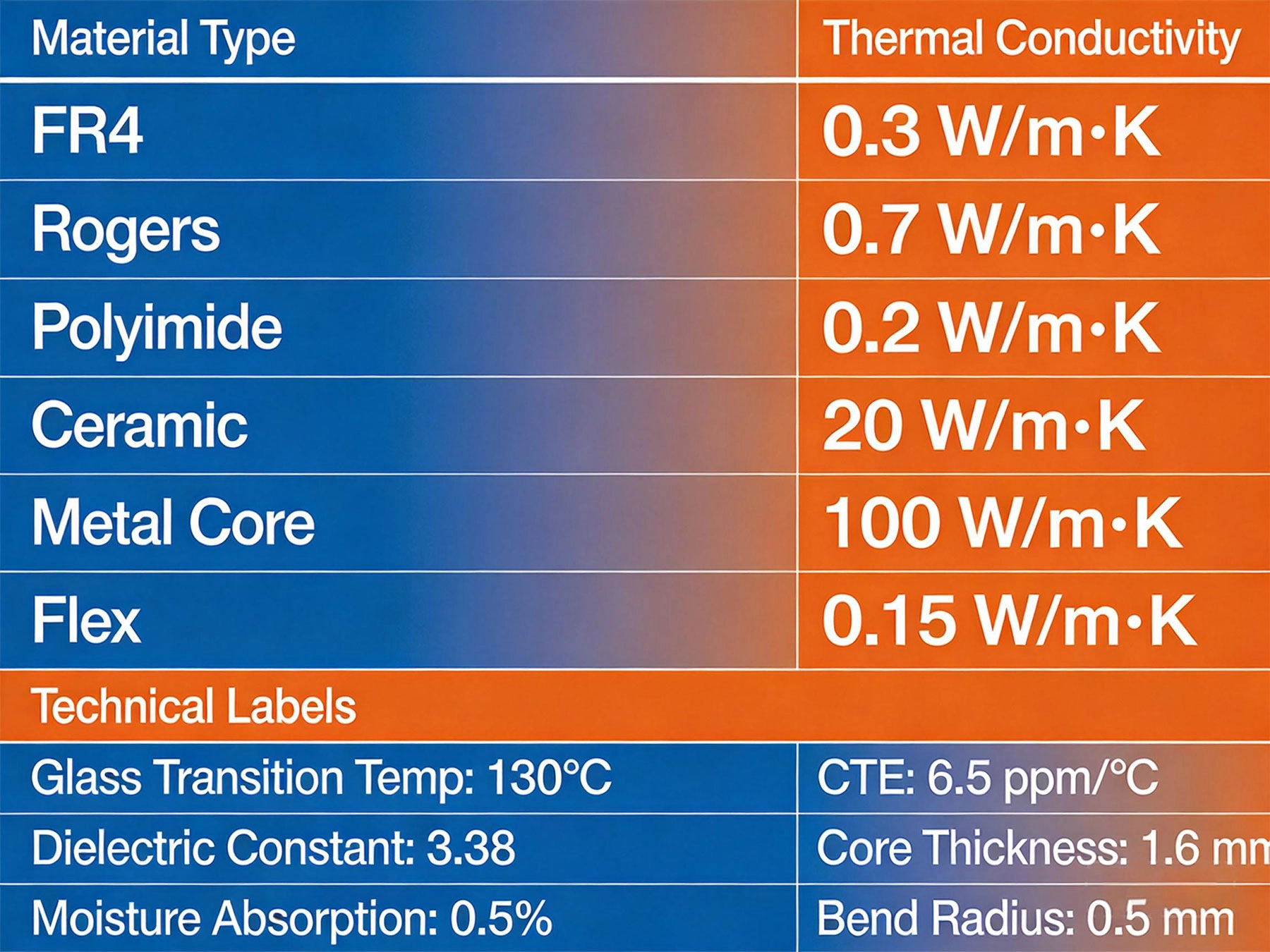
FR4 has served the electronics industry well for decades. It is inexpensive, reliable, and handles most applications adequately. But what happens when your application demands extreme temperatures, high frequencies, superior Thermal Management, or flexing during use? That is when you need to look beyond standard materials.
This guide explores the special PCB materials that solve problems FR4 cannot address, with practical guidance on when and how to use each.
Before diving into specific materials, here is how they compare on the key specifications that matter:
| Material | Max Temp | Thermal Conductivity | Dielectric Constant | Typical Cost vs FR4 |
|---|---|---|---|---|
| FR4 (Standard) | 130-140C | 0.3 W/mK | 4.2-4.5 | 1x |
| High-Tg FR4 | 170-180C | 0.4 W/mK | 4.2-4.5 | 1.3x |
| Polyimide (PI) | 260C | 0.35 W/mK | 3.5-4.2 | 3-5x |
| Rogers High-Freq | 200C | 0.5-1.0 W/mK | 2.1-11.2 | 5-15x |
| Aluminum Core (MCPCB) | 150C | 1-3 W/mK | 9.8 | 3-6x |
| Ceramic (Al2O3) | 500C+ | 20-30 W/mK | 9-10 | 20-50x |
The simplest upgrade from standard FR4. Same epoxy resin system, but with a higher glass transition temperature (Tg). The material remains stable at temperatures that would soften standard FR4.
Industrial motor controls, automotive ECUs, power supplies with high ambient temperatures, LED drivers in enclosed fixtures, any application requiring lead-free soldering.
Polyimide (often known by brand names like Kapton) is the material of choice when your PCB must flex during installation or operation. It can withstand millions of flex cycles when properly designed.
Smartphones and tablets, medical devices, aerospace wiring harnesses, automotive instrument clusters, industrial sensors in rotating equipment.
Standard FR4 has significant signal losses at high frequencies due to its resin system. Rogers materials (and competitors like Isola, Panasonic) are specifically engineered for RF and high-speed digital applications with controlled Dielectric Constant and minimal signal loss.
Below 1 GHz, FR4 performs adequately for most applications. Above 1 GHz, signal losses and dielectric constant variations become significant. Above 5 GHz, Rogers or equivalent materials become necessary for reliable performance.
5G base station antennas, Automotive radar (77GHz), WiFi and Bluetooth modules, satellite communications, military RF systems, high-speed digital interconnects at 10Gbps+.
Metal core PCBs replace the standard FR4 core with an aluminum or copper substrate. The metal core efficiently conducts heat from components, dramatically improving thermal performance compared to standard boards.
Metal core PCBs are typically limited to 1-2 layers. If you need both Thermal Management and complex multilayer routing, consider hybrid approaches or thermal vias in standard boards.
LED street lighting and automotive headlights, battery charging systems, high-power LED arrays, motor controllers in enclosed spaces, solar inverters.
Ceramic substrates (aluminum oxide Al2O3 and aluminum nitride AlN) offer extraordinary thermal conductivity and electrical isolation. They are the solution when power density exceeds what even metal core boards can handle.
Military radar systems, oil field instrumentation, aerospace Power Electronics, high-power LEDs, electric vehicle inverters, RF power amplifiers.
Modern PCB Fabrication allows combinations of materials in a single board. This enables designs that balance cost, performance, and manufacturability.
| Construction | Description | Best For |
|---|---|---|
| Rogers + FR4 | RF sections on Rogers, digital on FR4 | Wireless devices with baseband processing |
| Rigid + Flex | Rigid boards with flex connections | Space-constrained assemblies |
| FR4 + Aluminum | Standard board with thermal zones | Boards with high-power components |
| Multilayer hybrid | Different dielectrics per layer | Complex RF + digital boards |
Hybrid boards require careful communication with your fabricator. Some combinations require special processing steps, and not all manufacturers can produce all hybrid types. Always discuss your requirements upfront.
Start with this question: What is the primary problem you are solving?
If thermal management is the challenge:
If high frequency is the challenge:
If mechanical flexibility is the challenge:
If all requirements are moderate:
We frequently see designers specify Rogers or polyimide for applications where standard FR4 would perform adequately. The cost premium is substantial. Only specify special materials when you can demonstrate that FR4 cannot meet your requirements.
Special materials often have special processing requirements. Rogers materials may need different drill parameters, polyimide requires special handling during assembly, and ceramics need specialized mounting. Factor these into your design and budget.
Not all manufacturers can produce all material types. Before committing to a design, confirm that your chosen fabricator can actually build what you are designing. This avoids costly redesigns late in the process.
Material cost is only part of the total cost equation. Special materials often require extended lead times, special tooling charges, lower production yields, and additional testing and inspection. Get a complete cost estimate before finalizing your material choice.
The world of special PCB materials offers solutions to challenges that standard FR4 cannot address. The key is choosing the right material for your actual requirements, not over-engineering your solution.
Do not default to standard FR4 when you have real performance challenges. And do not specify exotic materials when standard materials will do. Match your material choice to your actual requirements, and always validate your choices with Prototype testing.
Case Study: How a German IoT Company Scaled Production with a Chinese PCB ManufacturerSeptember/01/2026
A Complete Guide to Importing Custom PCBs from China for US and EU StartupsJuly/16/2026
Common Pitfalls in Custom PCB Fabrication and How to Avoid ThemAugust/07/2026
Essential Tips for Your First Custom PCB OrderJune/02/2026

Rigid-Flex and Flexible PCBs: Unlocking New Possibilities with Custom DesignsJuly/17/2026
Overcoming Language and Cultural Barriers in Chinese PCB SourcingJuly/07/2026
Understanding Lead Times: What to Expect When Ordering from Chinese PCB MillsAugust/06/2026
The Rise of Smart Factories: How Automation is Revolutionizing China's PCB SectorJune/16/2026