
Electronics Product Development increasingly involves navigating complex supply chains that span multiple manufacturers, each responsible for a portion of the production process. This fragmentation—where PCB Fabrication flows to a separate assembly provider, which sends work to testing facilities, which coordinate with component distributors—creates friction that accumulates into significant delays, quality issues, and administrative burden. Integrated fab and assembly services consolidate these steps under single-source responsibility, transforming fragmented supply chains into streamlined production flows.
The benefits extend beyond simple convenience. When one organization controls fabrication, assembly, and testing, they can optimize processes holistically rather than maximizing efficiency for individual handoffs. Design decisions made during fabrication directly impact assembly yields. Assembly findings inform fabrication process improvements. Testing reveals process interactions invisible when each stage operates in isolation. This systemic visibility enables continuous improvement that fragmented supply chains simply cannot achieve.
This article examines how integrated fab and assembly services reduce Supply Chain friction, the operational mechanisms that create time savings, and practical considerations for evaluating integrated manufacturing partners.
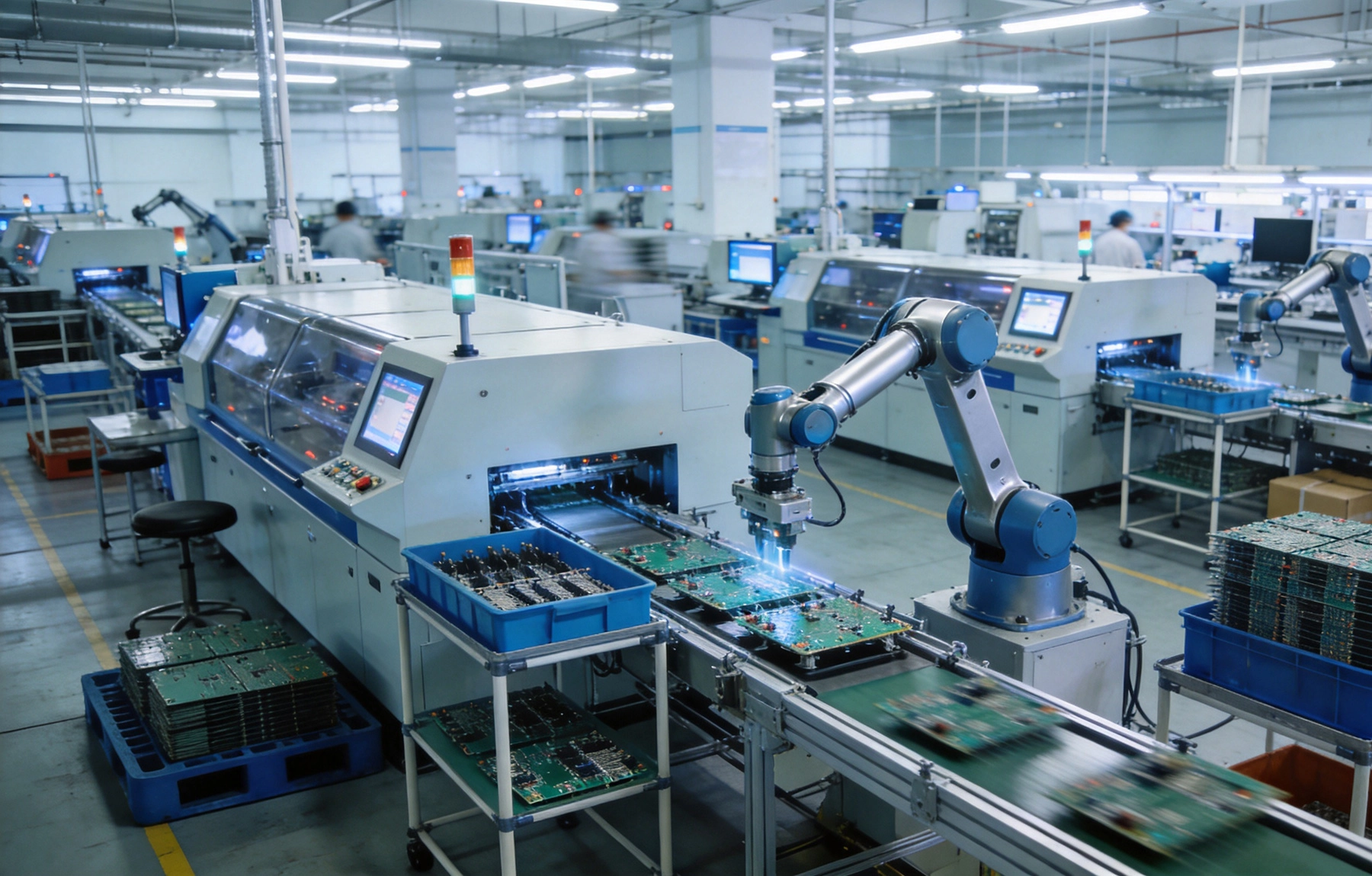
Supply Chain friction encompasses all the inefficiencies, delays, and quality risks that emerge when multiple organizations handle different production stages. While some friction results from legitimate business requirements, much of it reflects structural inefficiencies in how Electronics Manufacturing evolved historically.
Traditional Electronics Manufacturing separates stages that could logically integrate:
Each handoff introduces latency: shipping time between facilities, communication delays for issue resolution, administrative processing for orders and invoicing. For simple products with long production runs, these delays might represent acceptable overhead. For complex industrial products with tight development timelines, accumulated friction becomes a competitive disadvantage.
Most supply chain friction originates in communication challenges:
Specification Translation: Design intent expressed in fabrication documentation may not translate clearly to assembly requirements. Boards fabricated to tolerances that seem acceptable may create assembly challenges invisible until components are placed.
Issue Escalation Delays: When problems emerge, routing through multiple organizations extends resolution time. A fabrication issue affecting assembly requires communication through sales representatives and project managers rather than direct engineering consultation.
Process Knowledge Gaps: Each organization understands only their portion of production. Assembly providers may not recognize why certain fabrication characteristics exist; fabrication shops may not understand assembly process sensitivities.
Documentation Propagation: Material certifications, process parameters, and quality records must transfer between organizations. Delays in documentation transfer hold up production while information catches up.
Integrated fab and assembly services eliminate friction by collapsing multiple handoffs into unified operations. The mechanisms creating these benefits reflect fundamental operational realities rather than marketing claims.
When fabrication and assembly share a facility, process visibility becomes immediate rather than reported:
Immediate Feedback: Assembly operators observe fabrication characteristics that affect placement and soldering. Surface finish variations, board bow, or documentation ambiguities surface immediately rather than causing downstream delays.
Engineering Access: Fabrication engineers directly consult with assembly engineers when design-for-manufacturing issues emerge. This collaboration resolves problems in hours rather than days of email and phone tag.
Process Optimization: Observations from assembly—Solderability issues, placement challenges, test failures—inform fabrication process adjustments. This continuous feedback loop improves quality without formal corrective action documentation cycles.
Physical movement between facilities consumes time regardless of organizational efficiency:
Eliminated Shipping Delays: Boards move from fabrication to assembly within the same facility, requiring minutes rather than days. For urgent requirements, this eliminates entire production cycle days.
Packaging and Handling Reduction: Each shipment requires protective packaging, handling during transit, and receiving inspection at destination. Eliminating intermediate shipments reduces cost and damage risk.
Consolidated Shipping: Component shipments flow to a single destination rather than coordinating deliveries to multiple facilities with different receiving procedures and schedules.
Information moves faster within organizations than between them:
Unified Quality Systems: Documentation requirements align automatically since the same quality system covers both fabrication and assembly. No translation between different quality management frameworks.
Traceability Without Interfaces: Component traceability from procurement through assembly remains continuous. Lot codes, date codes, and process records connect naturally rather than requiring interface documentation.
Simplified Audit Access: Quality audits cover fabrication and assembly in single visits rather than requiring multiple audit arrangements across different organizations.
Integrated services deliver time savings throughout production, from initial Prototype through volume delivery.
New product introduction particularly benefits from integration:
Accelerated Iterations: Prototype boards that require design modifications move immediately to revised fabrication. Turnaround times reflect only manufacturing processes rather than adding inter-facility transit.
Design For Manufacturability Collaboration: Fabricators who understand assembly processes provide more actionable Dfm feedback. They recognize what assembly challenges specific designs will create and suggest modifications before tooling commits.
Test Development Parallelization: Test fixtures and programs can develop alongside board fabrication rather than waiting for boards to arrive at separate test facilities.
Initial production runs reveal process issues that integration helps resolve:
Yield Improvement Speed: Assembly yield issues trace to fabrication root causes and resolve faster when engineering teams share physical space and organizational priorities.
Process Parameter Transfer: Optimal reflow profiles, placement adjustments, and inspection criteria established during NPI apply directly to production without revalidation at separate facilities.
First Article Coordination: First article inspection covers fabrication and assembly together. Discrepancies between design intent and manufacturing output resolve faster when same-organization teams address them.
Ongoing production benefits from operational efficiencies:
Capacity Coordination: Fabrication and assembly capacity align automatically. No risk of fabricating boards that wait for assembly slot availability or vice versa.
Expedited Responsiveness: Schedule changes, rush orders, and priority adjustments coordinate through single planning function rather than requiring parallel communications with multiple vendors.
Consistent Quality Experience: Quality systems and process controls remain consistent across fabrication and assembly. Variables that cause quality variation in fragmented supply chains disappear when same-organization teams execute both processes.
While unit pricing often receives primary attention in manufacturing quotes, total cost of ownership reveals the true economics of supply chain structure.
Several cost factors hide in fragmented supply chains:
Engineering Coordination: Technical issues requiring fabrication-assembly coordination consume engineering time across multiple organizations. Each organization bills for engineering consultation, and coordination overhead multiplies with additional supply chain partners.
Quality Investigation Overhead: When defects occur, determining whether root cause lies in fabrication or assembly requires investigation across organizations. Accountability diffusion extends root cause analysis timelines and increases total investigation cost.
Inventory Carrying Cost: Separate fabrication and assembly creates buffer inventory at each stage. This inventory ties up working capital and requires management overhead.
Logistics Cost: Shipping between facilities adds direct cost plus administrative overhead for freight coordination, customs (for international shipments), and receiving processing.
Rework and Return Processing: Defects discovered at assembly may require board returns to fabrication or component re-procurement. Each return involves administrative processing, shipping, and delayed resolution.
Integration creates value difficult to quantify but significant in practice:
Time-to-Market Acceleration: Faster production cycles enable earlier market entry. For products with competitive windows, this time advantage creates revenue that exceeds any unit cost difference.
Quality Risk Reduction: Integrated quality systems reduce defect escape rates. Field failures generate warranty costs, customer dissatisfaction, and reputation damage that exceed the cost of higher-quality initial production.
Supply Chain Simplification: Managing one manufacturing relationship rather than multiple reduces procurement overhead, invoice processing, and supplier management burden.
Intellectual Property Protection: Design information remains within one organization rather than flowing to multiple partners. This containment reduces accidental disclosure risk and competitive intelligence exposure.
Not all integrated services deliver equivalent value. Effective evaluation requires understanding what distinguishes capable integrated manufacturers from those offering superficial consolidation.
True integration requires genuine capability in each stage:
Fabrication Capability Parity: An integrated provider should offer fabrication capabilities matching specialized board shops. Layer count, material options, and quality certifications should not diminish because assembly occurs in-house.
Assembly Technology Range: Assembly operations should handle your technology requirements—SMT density, through-hole capabilities, BGA and fine-pitch placement, flex circuit assembly, or specialized mounting requirements.
Testing Integration: Inspection and test capabilities should match what specialized test houses offer: Aoi, X-ray, Ict, functional test, and any specialized testing your products require.
Marketing claims require operational evidence:
Unified Engineering Teams: Fabrication and assembly engineers should collaborate directly rather than operating as separate departments connected only through project managers.
Shared Quality Systems: Quality documentation should flow continuously between fabrication and assembly rather than existing as separate quality systems for each operation.
Physical Proximity: Ideally, fabrication and assembly occur in the same facility. If separate facilities exist, evaluate whether genuine integration exists or whether this merely represents common ownership of separate operations.
Experience with similar products indicates capability:
Relevant Product Experience: Ask for examples of products similar to yours—same technology complexity, similar volumes, comparable quality requirements. General electronics experience may not translate to your specific application.
Volume Production History: NPI capability does not guarantee volume production competence. Request examples of long-running production programs that demonstrate sustained quality and responsiveness.
Customer References: Contact references directly to discuss their experience with integration benefits, issue resolution, and ongoing partnership satisfaction.
Integration offers clear advantages, but some scenarios favor continued fragmentation:
Products with extreme technical requirements may exceed integrated providers' capabilities:
Leading-Edge Technology: Some products require fabrication processes beyond what integrated assembly facilities support. Specialized board shops may offer capabilities unavailable in integrated operations.
Unique Assembly Requirements: Highly specialized assembly—medical device packaging, aerospace conformance, or defense compliance—may require specific certifications or processes that general integrated providers cannot offer.
Existing relationships may create strategic value:
Long-Term Partnership Value: Decades-long relationships with specific fabricators or assemblers may provide pricing, priority, or responsiveness unavailable from new integrated partners.
Geographic Requirements: Some products require local manufacturing for logistics, regulatory, or business reasons. Integrated providers may not exist in required regions.
Single-source concentration creates risk some organizations prefer to avoid:
Supply Security: Some procurement strategies deliberately distribute production across multiple suppliers to reduce single-point-of-failure risk.
Pricing Leverage: Maintaining alternative suppliers provides negotiation leverage that consolidated relationships may reduce.
Transitioning from fragmented supply chains requires thoughtful execution:
Avoid complete dependency switch until validation completes:
Parallel Production: Initially produce at both integrated provider and existing suppliers. Compare quality, responsiveness, and cost before reducing legacy relationships.
Product Line Prioritization: Start integration with lower-risk products—those with less critical quality requirements, longer timelines, or smaller volumes. Validate capability before migrating mission-critical products.
Smooth transitions require complete information transfer:
Complete Design Files: Provide all fabrication and assembly documentation: Gerber Files, drill files, BOM, pick-and-place data, assembly drawings, and quality specifications. Incomplete information causes transition delays.
Process History Sharing: Share lessons learned from existing production—known problem areas, successful workarounds, optimal process parameters. This institutional knowledge prevents repeating mistakes.
Acceptance Criteria Alignment: Ensure integrated provider understands acceptance criteria that existing suppliers follow. Differences in inspection standards cause apparent quality gaps that reflect measurement differences rather than actual defects.
Integration benefits increase with partnership depth:
Engineering Engagement: Connect your engineering team with the integrated provider's engineering team early. Face-to-face relationships built during NPI pay dividends during production.
Regular Business Reviews: Establish periodic reviews covering quality metrics, capacity planning, and improvement opportunities. Partnership quality improves with structured attention.
Long-Term Commitment Signals: Signal commitment through volume forecasts, product roadmap sharing, and multi-year relationship intentions. Providers invest more deeply in partners who demonstrate stability.
Supply chain friction in electronics manufacturing accumulates from multiple sources: inter-facility transit, communication delays, documentation gaps, and organizational boundaries. Integrated fab and assembly services eliminate these friction sources by consolidating production under unified operational control.
The time savings from integration manifest across production phases—faster NPI iterations, smoother production ramps, and more responsive ongoing production. These time advantages translate to earlier market entry, reduced working capital requirements, and improved customer satisfaction. Beyond direct time savings, integration reduces hidden costs of coordination overhead, quality investigation, and inventory carrying that fragment across multiple supply chain relationships.
Not every product requires integrated services. Highly specialized requirements, strategic supplier relationships, and risk diversification considerations may favor continued fragmentation. However, for products where time-to-market matters, supply chain simplicity provides value, and quality consistency matters, integrated fab and assembly delivers measurable advantages that fragmented supply chains cannot match.
Evaluating integrated manufacturing partners requires attention to genuine operational integration rather than surface-level consolidation. The benefits described here flow from providers where fabrication and assembly engineering teams collaborate directly, quality systems unify naturally, and process optimization spans the complete production lifecycle. Due diligence during partner selection ensures integration delivers promised benefits rather than creating new friction through organizational complexity disguised as unified services.
Integrated fab and assembly means the same organization performs both Pcb Fabrication (board manufacturing) and Pcb Assembly (component placement and soldering). This consolidation eliminates shipping between facilities, unifies quality systems, and enables direct engineering collaboration across production stages. The level of integration varies—some providers operate both processes in the same facility while others maintain separate buildings or locations under common ownership.
Time savings vary by product complexity and existing supply chain efficiency. Typical integrated services reduce total production cycle time by 20-40% compared to fragmented supply chains with separate fabrication and assembly. For prototype turns, savings often exceed 50% since inter-facility transit alone typically adds 5-10 business days. Volume production savings accumulate from eliminated shipping delays, faster issue resolution, and reduced coordination overhead.
Unit pricing for integrated services may appear higher because they include both fabrication and assembly costs. However, total cost of ownership often favors integration when accounting for logistics, coordination overhead, inventory carrying costs, and quality risk. Request total cost comparisons rather than unit price comparisons to evaluate true economic impact.
Look for ISO 9001 for quality management systems, Iso 13485 for medical applications, and AS9100 for aerospace products. For IPC compliance, verify both fabrication (IPC-6012 for rigid boards, IPC-6013 for flexible circuits) and assembly (Ipc-a-610 for workmanship standards). Third-party certifications provide confidence in quality system implementation.
Capability varies significantly among integrated providers. Some offer advanced capabilities matching or exceeding specialized board shops—high layer counts, advanced materials, buried/Blind Vias, and Controlled Impedance. Others focus on standard products where fabrication complexity doesn't exceed assembly facility capabilities. Verify specific technical requirements match provider capabilities rather than assuming integration implies unlimited technical range.
The Advantages of HDI PCB Fabrication for Compact ElectronicsMay/22/2026
Applications Driving the Demand for HDI PCBs: From Smartphones to Medical DevicesSeptember/17/2026
Managing Cost and Quality in Quick Turn PCBsJune/04/2026
Choosing the Right Assembly Partner: Capabilities, Capabilities, Certifications, and CapacitySeptember/28/2026
Case Study: How a German IoT Company Scaled Production with a Chinese PCB ManufacturerSeptember/01/2026
Why Startups Rely on Quick Turn Fabrication to Secure Funding FasterAugust/08/2026
Why Global Brands Are Turning to PCB Fabrication in China in 2026May/21/2026
The Logistics of Speed: Shipping and Handling for Urgent PCB DeliveriesSeptember/03/2026