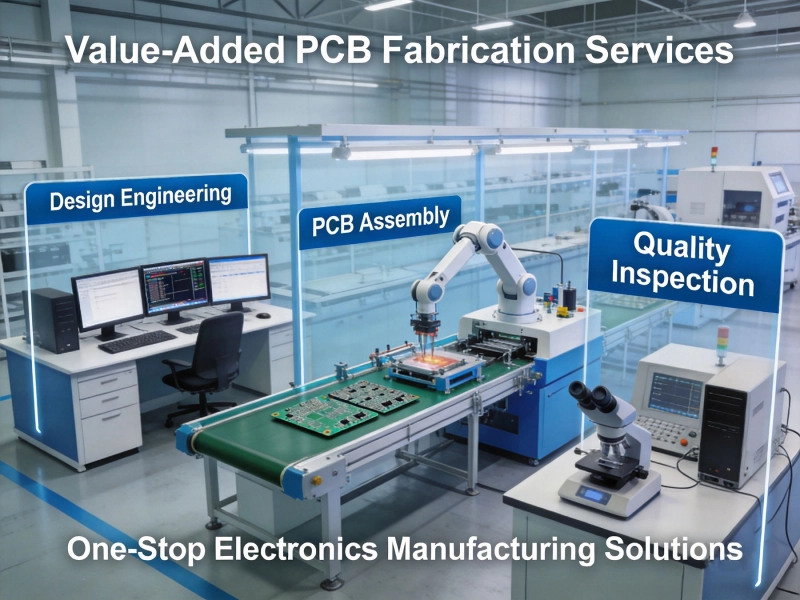
Choosing a PCB vendor is one of the most consequential Supply Chain decisions an electronics company makes. The wrong choice shows up as missed deadlines, quality escapes that reach your customers, and endless firefighting that drains engineering bandwidth. The right choice disappears into the background—boards arrive on time, quality is consistent, and when problems do arise they are resolved before you even hear about them. That difference is not about price or lead time on a quote. It is about whether the vendor operates as a supplier or as a partner. This article defines what service orientation really means in Pcb Manufacturing and gives you a framework for evaluating vendors beyond the superficial metrics that dominate most selection processes.

Supplier vs. Partner: The Fundamental Distinction
A supplier executes transactions. You send Gerber Files, they send a quote, you place an order, they ship boards. If there is a problem, you escalate through a support ticket and wait. The relationship is defined by the contract and nothing more.
A partner takes ownership of outcomes. They review your design before committing to production and flag issues you may have missed. They suggest improvements—not to upsell, but because they have seen what works and what fails across thousands of builds. When a component goes on allocation, they tell you before your build is at risk. When yields drift, they investigate and correct before you receive defective product. The relationship is defined by mutual investment in each other's success.
Most companies say they want a partner. Most selection processes—dominated by quote comparisons and capability checklists—are optimized to find a supplier. The gap between intention and outcome starts with how you evaluate.
Service Orientation: More Than Responsiveness
Service orientation is often conflated with fast response times—how quickly the vendor replies to emails or picks up the phone. Responsiveness matters, but it is table stakes. True service orientation manifests in seven dimensions that distinguish partners from suppliers.
1. Proactive Communication
A service-oriented vendor tells you what you need to know before you have to ask. This includes:
- Dfm feedback during quoting: Not just a price, but observations about your design—potential yield risks, stack-up concerns, clearance violations. A vendor that quotes without reviewing is a vendor that will be surprised during production.
- Early warning on risks: Component allocation alerts, material availability issues, capacity constraints during peak seasons. You should hear about these when there is still time to act, not when your order is already queued.
- Transparent milestone updates: Real-time order tracking that shows where your build is in the process—not a binary "in production" status that tells you nothing.
- Bad news without delay: When something goes wrong—a test failure, a yield drop, a shipping delay—the partner vendor communicates immediately with a clear description of the issue, the root cause analysis, and the corrective action plan. They do not wait until the ship date to reveal a problem.
2. Technical Depth in Engineering Support
The quality of Engineering Support is the sharpest differentiator between vendors. Critical questions to assess:
- Who reviews your design—the same engineer who will own the production build, or a separate quotation team that hands off to manufacturing with no context?
- Can the vendor explain why they recommend a specific stack-up or finish, with reference to your application requirements—not just quote the default?
- Do they have subject-matter experts in the technologies relevant to your product (HDI, flex, high-frequency materials, heavy copper) rather than generalists?
- When you call with a technical question, do you reach an engineer or a customer service representative reading from a script?
Shallow Engineering Support forces your own team to fill the gap—doing Dfm reviews that the vendor should have done, debugging process issues that the vendor should have prevented, and specifying parameters that the vendor should have recommended. That hidden labor cost is rarely captured in vendor cost comparisons.
3. Quality System Maturity
Certifications (ISO 9001, Iso 13485, Iatf 16949) are necessary but not sufficient. They indicate that a quality management system exists, but they do not reveal how effectively it operates. Evaluate the substance behind the certificate:
- CAPA process: How does the vendor handle corrective and preventive actions? Ask for a recent example—what triggered the CAPA, what root cause was identified, what corrective action was implemented, and how effectiveness was verified. A vendor that cannot articulate this process is checking boxes, not driving improvement.
- Process capability data: Does the vendor track Cpk for critical process parameters (lamination thickness, drill accuracy, plating uniformity)? Can they share trend data showing stable or improving capability? A vendor that manages by inspection rather than by process control will have quality excursions that no amount of incoming inspection can catch.
- Traceability: Can the vendor trace a finished board back to the specific lot of laminate, copper foil, and plating bath? Full material and process traceability is essential for regulated industries and invaluable for root cause analysis on any product.
- First-article rigor: How comprehensive is the first-article inspection report? Does it include dimensional measurement, Cross-section Analysis, and electrical test results—or just a visual check?
4. Continuous Improvement Culture
A partner vendor gets better over time. A supplier stays the same. Signs of a continuous improvement culture:
- Yield trend tracking: The vendor monitors first-pass yield by product and by process step, and they proactively address negative trends before they affect delivery quality.
- Cost reduction suggestions: Not just accepting your current design, but recommending changes that reduce cost without compromising performance—alternative finishes, optimized panelization, stack-up simplifications. A vendor that only looks for ways to increase margin on their end is a supplier. A vendor that looks for ways to reduce your total cost is a partner.
- Technology investment: Adding capabilities that align with your product roadmap—not just buying equipment for marketing brochures. If your next-generation design needs HDI Via-in-pad, and the vendor is investing in laser drill capacity, that is alignment. If they are investing in capabilities you will never use, that is divergence.
- Lessons-learned sharing: A vendor that shares process insights from other customers' experiences (without disclosing confidential information) helps you avoid problems you have not encountered yet.
5. Flexibility and Responsiveness to Change
Product Development is inherently unpredictable. Design changes, schedule shifts, and volume fluctuations are the norm. How a vendor responds to change reveals their true service orientation:
- Engineering change orders: Does the vendor process ECOs efficiently, or does each change trigger a bureaucratic cycle that adds weeks? A partner has streamlined ECO processes with dedicated engineering support for change implementation.
- Volume flexibility: Can they handle Prototype quantities this month and production volumes next quarter without minimum-order penalties or setup charges that make small builds uneconomical? The ability to scale with you—rather than forcing you to fit their economic model—is a hallmark of service orientation.
- Schedule accommodation: When you need to expedite—really expedite, not just ask—a partner vendor finds a way. They adjust their schedule, pull in materials, or run overtime. They do not just say "we will try" and then deliver late.
- Design iteration support: In early development, you may need multiple quick-turn iterations. A vendor that penalizes iteration (high NRE charges, long setup times per revision) is optimized for stable production, not for the reality of Product Development.
6. Financial Stability and Strategic Alignment
A partnership only works if both parties are around for the long term. Financial instability in a vendor creates existential risk:
- Capacity contraction: A vendor under financial pressure may cut equipment maintenance, reduce inspection frequency, or lay off experienced engineers—all of which directly affect your product quality.
- Sudden closure: Losing a vendor with your tooling, test fixtures, and production history is a major disruption. Dual-sourcing mitigates this risk, but dual-sourcing with two shallow suppliers is worse than single-sourcing with one deep partner.
- Ownership changes: Private equity acquisitions of PCB fabricators have become common. The new owner's priorities—cost reduction, asset stripping, short-term margin—may not align with the service orientation that attracted you to the vendor in the first place.
Ask about the vendor's ownership structure, capital investment plans, and financial health. A transparent partner shares this context. An evasive one may have something to hide.
7. Cultural Fit and Relationship Depth
This is the intangible factor that most selection processes ignore—and the one that most often determines whether a vendor relationship succeeds or fails over time:
- Account management structure: Do you have a named account manager who knows your products, your team, and your priorities? Or do you call a generic support line and get a different person each time?
- Executive accessibility: When issues escalate, can you reach someone with authority to make decisions—or are you stuck in a support queue whose resolution path is "please wait 5–7 business days"?
- Visit readiness: A partner vendor welcomes facility visits. They want you to see their operation, meet their team, and understand their process. A vendor that discourages visits or limits access to a conference room is hiding something.
- Language and time zone alignment: Communication friction from language barriers or time zone offsets compounds over time. It is not just about whether you can understand each other—it is about whether nuanced technical discussions happen efficiently or require multiple rounds of clarification.
Evaluating Vendors: A Practical Framework
Most vendor selection processes over-weight price and under-weight service. Here is a structured evaluation approach that corrects that imbalance:
Phase 1: Capability Screening
Eliminate vendors that cannot build your product. This is a binary filter:
- Layer count, board thickness, and material compatibility
- Minimum trace/space and via dimensions
- Surface finish options
- Maximum panel size and copper weight range
- Required certifications for your industry
Do not over-weight capability at this stage. A vendor that meets 90% of your requirements but excels in service orientation is often a better long-term choice than one that meets 100% of requirements but operates as a transactional supplier—especially if the missing capability is for an edge-case design that may never reach production.
Phase 2: Service Orientation Assessment
Score shortlisted vendors against the seven dimensions described above. Use a structured scorecard with weighted criteria aligned to your priorities. Key evaluation methods:
- Reference checks: Talk to customers with similar products and volumes. Ask specifically about the vendor's behavior when things went wrong—not when everything went right. A vendor's character is revealed in crisis, not in routine.
- Quotation process observation: The quotation process itself is a diagnostic. Did the vendor ask clarifying questions? Did they provide DFM feedback? Did they suggest alternatives? A quote that arrives as a single number with no context is a red flag.
- Pilot build evaluation: Place a small order and observe the full experience—from order entry through delivery. Was communication proactive? Were issues flagged early? Was the documentation comprehensive? The pilot build is the most reliable predictor of long-term behavior.
- Facility visit: Walk the production floor. Talk to the engineers who will actually build your boards. Observe the level of organization, cleanliness, and process discipline. The gap between a vendor's marketing and their production floor reality is often significant.
Phase 3: Total Cost of Ownership Analysis
Compare vendors on total cost, not unit price. Total cost includes:
- Board unit price (the line item everyone compares)
- Your internal engineering overhead for vendor management, Dfm Review, and issue resolution
- Rework and scrap costs from quality escapes
- Expedite fees and premium freight from late deliveries
- Opportunity cost from schedule delays (the largest and most frequently ignored component)
- Risk-adjusted cost of vendor failure (financial instability, capacity loss, quality regression)
In most cases, the total cost of a service-oriented partner is 10–20% lower than the total cost of a transactional supplier—even when the partner's unit price is 5–10% higher. The savings come from reduced internal overhead, fewer quality escapes, and fewer schedule disruptions.
Red Flags: Signs of a Transactional Vendor
Save yourself the pain of discovering these through experience. Watch for these warning signs during evaluation:
- Quotes that arrive as a single number with no technical feedback or observations
- No dedicated account manager—you interact with a different person each time
- Quality issues reported by you rather than by the vendor (they did not catch it, or they caught it and shipped it anyway)
- Consistent on-time delivery in the low 90s% or below, with no improvement trend
- Requests for information or ECOs that require multiple follow-ups
- Reluctance to share process data, yield trends, or CAPA histories
- Facility visits restricted or limited to conference rooms
- Pricing that seems too good to be true (it probably is—cost is being recovered through quality shortcuts or service omission)
Green Flags: Signs of a True Partner
- DFM feedback arrives with the quote, before you ask for it
- A named account manager who knows your products and contacts you proactively
- First-article reports that are thorough enough to require no follow-up questions
- Yield and delivery metrics shared without being requested
- Component allocation or material risk alerts before your build is affected
- Cost reduction ideas that save you money without degrading performance
- Willingness to invest in capabilities specific to your product roadmap
- Open facility access with introductions to the engineering and production teams
Investing in the Relationship
A partnership is not one-sided. The customer also has responsibilities that determine whether the vendor can deliver partner-level service:
- Design For Manufacturability: A partner vendor will provide DFM feedback, but you must act on it. Ignoring repeated DFM warnings erodes the vendor's willingness to invest effort in future reviews.
- Forecast visibility: Share your demand forecast—even an imperfect one. A vendor that can plan capacity for your product delivers more reliably than one that receives orders with no context.
- Stable requirements: Minimize late ECOs and scope changes after production setup. Some change is inevitable; constant change is a relationship killer.
- Reasonable timelines: Push the vendor for speed when you need it, but do not make every order an expedite. Constant urgency desensitizes the vendor to genuinely critical requests.
- Timely feedback: When you receive boards, report any issues promptly. Quality data from the field helps the vendor improve their process. Delayed or absent feedback deprives them of the information they need to be a better partner.
When to Dual-Source vs. Single-Source
The partnership model works best with a primary vendor who handles the majority of your volume, supplemented by a qualified secondary source for risk mitigation. Full dual-sourcing—splitting every order 50/50—prevents either vendor from achieving the volume and familiarity that enables partner-level service. A practical split:
- Primary partner: 70–80% of volume. Deep relationship, full DFM engagement, custom process optimization, priority scheduling.
- Secondary source: 20–30% of volume. Qualified and intermittently validated, but not expected to provide the same level of service. Purpose is supply continuity risk mitigation, not cost competition.
Periodically qualify the secondary source by placing production-intent orders—not just Prototype builds, which do not exercise the full production process. This ensures the secondary vendor can actually deliver if the primary becomes unavailable.
Conclusion
The difference between a Pcb Supplier and a PCB partner is not captured on any quote or capability matrix. It lives in the depth of engineering support, the proactiveness of communication, the maturity of the quality system, and the cultural commitment to your success. Selecting a vendor based solely on price and capability is a transaction that will need to be repeated every few years when the cheapest supplier fails to deliver. Selecting based on service orientation is an investment that compounds—delivering lower total cost, higher quality, faster time to market, and the peace of mind that comes from knowing your Supply Chain is in capable hands. Use the evaluation framework described here to look past the surface metrics and find a vendor worth building with for the long term.
Contact us to discuss your requirements.