Open Nav

Selecting the right surface finish for your PCB is one of those decisions that looks simple on paper but carries real consequences for solderability, shelf life, Signal Integrity, and cost. Each finish—ENIG, HASL, OSP, and immersion silver—has a distinct set of properties that make it better suited for some applications than others. Understanding those properties helps you avoid assembly defects, field failures, and unnecessary cost.
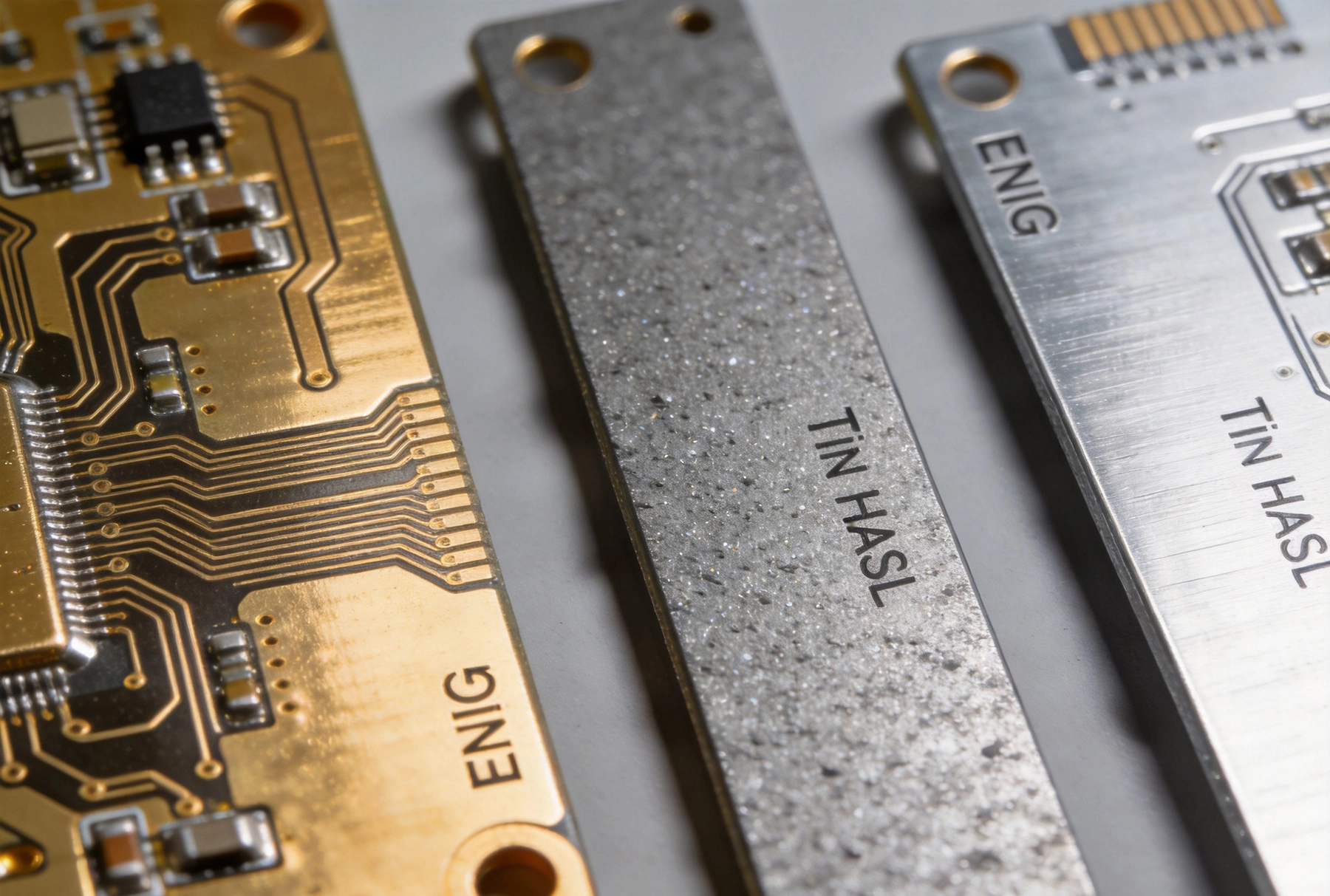
After a PCB is fabricated, the exposed copper traces and pads must be protected from oxidation. Bare copper oxidizes quickly when exposed to air, forming a surface that does not solder well. Surface finishes serve two purposes: protecting the copper from oxidation and providing a solderable surface for component attachment.
Different finishes achieve these goals through different mechanisms and with different characteristics. The choice affects how well components solder, how long the boards can be stored before assembly, how the board performs in high-frequency applications, and what the finished assembly looks like.
ENIG deposits a layer of nickel covered by a thin layer of immersion gold over the copper pads. The nickel acts as a barrier layer, preventing copper from diffusing into the gold. The gold protects the nickel during storage and dissolves during soldering, exposing the underlying nickel for the solder joint to bond with.
ENIG produces a flat, uniform surface that is ideal for fine-pitch components like BGAs, QFNs, and 0201 resistors. The flatness ensures reliable solder paste release from stencils and accurate component placement. ENIG also holds up well to multiple reflow cycles, making it suitable for boards with components on both sides.
The main drawback of ENIG is cost. It is one of the most expensive surface finishes, roughly two to three times the cost of HASL in many fabrication quotes. ENIG also requires careful process control. If the nickel layer is too thin or improperly deposited, it can cause "black pad" failure—a condition where the nickel surface degrades and creates a brittle or non-wetting solder joint. Experienced fabricators manage this risk through process validation and bath chemistry monitoring.
For high-frequency applications, ENIG is generally a good choice because the gold surface provides stable contact resistance and does not tarnish. However, the thin gold layer does add a small amount of impedance at very high frequencies, which matters for millimeter-wave applications above 30 GHz.
HASL applies a layer of tin-lead solder to the copper surface by dipping the board in molten solder and then leveling it with hot air knives. The result is a relatively thick coating—typically 1–2 mils—that provides excellent solderability and long shelf life.
HASL is the most economical surface finish and the most widely available. It handles thermal cycling well because the thick solder layer can absorb some stress without cracking. It is forgiving of surface irregularities and works well with through-hole components where the solder must wick into holes.
The disadvantages are equally notable. The HASL process produces an uneven surface with thickness variation across the board and especially at the edges of large pads. This topography makes HASL poorly suited for fine-pitch surface mount components, where uneven solder paste deposition can cause tombstoning or bridging. Boards finished with HASL also have limited flatness, which complicates vacuum pickup for automated placement.
Lead-free HASL (LF-HASL) using tin-copper or tin-silver-copper alloys has replaced traditional tin-lead HASL in most commercial production due to Rohs Compliance requirements. The lead-free variants are harder than tin-lead and may have slightly different wetting characteristics, but they serve the same general purpose.
OSP applies a thin, transparent organic coating over the copper surface. This coating protects the copper from oxidation but is designed to be displaced by flux during the soldering process, allowing the solder to bond directly with the copper.
OSP is one of the least expensive finishes after HASL and provides excellent flatness. It is popular for high-volume consumer electronics where cost matters and the component mix does not demand exotic finishes. OSP is also considered more environmentally friendly than ENIG because it does not use gold or nickel.
The critical limitation of OSP is shelf life. An OSP-finished board stored in ideal conditions—sealed bag, low humidity, controlled temperature—may remain solderable for 6–12 months. In humid or warm storage conditions, this window shortens significantly. Once the OSP coating degrades, the underlying copper oxidizes and becomes difficult to solder reliably. This makes OSP a poor choice for slow-turn projects or supply chains where boards might sit in warehouse storage for extended periods.
OSP is also sensitive to multiple reflow cycles. The coating burns off during the first reflow and is gone by the second. For double-sided assembly, this means the second side must be hand-soldered or the board must be assembled in a way that only requires one reflow pass.
Immersion silver deposits a thin layer of silver directly onto the copper surface through a chemical displacement reaction. The silver layer is typically 5–15 microinches thick and provides good solderability with a relatively flat surface.
Immersion silver strikes a balance between cost and performance. It is less expensive than ENIG but more expensive than OSP or HASL. It provides better flatness than HASL and longer shelf life than OSP—typically 6–12 months in sealed packaging with desiccant.
The main concern with immersion silver is tarnishing. Silver sulfide forms on the surface when exposed to sulfur-containing environments, which can come from industrial air, certain adhesives, or even human skin oils. While flux generally cleans tarnish during soldering, heavy tarnishing can cause wetting issues. Best practice is to assemble immersion silver boards within a few weeks of receipt and store them in sealed bags with desiccant.
Immersion silver is a solid choice for high-frequency PCBs because silver has lower bulk resistance than gold and excellent conductivity at high frequencies. It is increasingly used in RF and microwave applications where ENIG's slightly higher impedance at millimeter-wave frequencies is a concern.
For fine-pitch components and BGAs, ENIG is the preferred choice because of its flatness and uniformity. HASL is not suitable for fine pitch due to surface unevenness. OSP can work but requires careful handling and single-reflow assembly. Immersion silver provides acceptable flatness for most fine-pitch applications.
For through-hole and mixed-technology boards, HASL remains popular because the thick solder layer helps fill plated through-holes. ENIG can work for through-hole but requires adequate solder paste volume. OSP and immersion silver are generally acceptable for through-hole but may need adjusted paste volume or flux strategies.
For lead-free assembly, all four finishes work, but ENIG and LF-HASL are the most established. OSP requires careful profile tuning for lead-free reflow because the higher peak temperatures can affect the coating. Immersion silver handles lead-free profiles well.
For shelf life and storage, HASL and ENIG offer the longest protection—12 months or more in proper storage. OSP has the shortest effective shelf life. Immersion silver falls in the middle, with 6–12 months typical.
For cost, HASL is the lowest-cost option, followed by OSP and immersion silver, with ENIG the most expensive. The cost difference often narrows at high volumes or for large panel orders.
Start by considering the component types on your board. If you have BGAs or fine-pitch QFNs, ENIG is almost always the right choice despite the cost premium. The improved solderability and reduced assembly defect rate justify the investment. If your board is all through-hole or large-pitch components, HASL may be perfectly adequate.
Consider your Supply Chain timeline. If boards might sit in storage for months before assembly, avoid OSP. If you have fast turnaround from fabrication to assembly, OSP is viable and cost-effective. For anything in between, immersion silver offers a reasonable compromise.
Factor in your assembly process. If you run double-sided reflow, ENIG or LF-HASL handle multiple thermal cycles better than OSP. If you use wave soldering for through-hole components, HASL or ENIG provide the most robust solderability.
Finally, discuss options with your fabrication partner. They know their process capabilities and which finishes they produce in-house versus outsource. A fabricator with strong ENIG process control can deliver consistent results, while one treating it as an add-on service may have higher defect rates.

Best Practices for Preparing Files for Expedited PCB ManufacturingJuly/29/2026
24-Hour Turnaround: Is it Possible and How Does it Work?May/21/2026
Microvias and Blind/Buried Vias: Key Technologies in HDI FabricationAugust/11/2026
The Logistics of Speed: Shipping and Handling for Urgent PCB DeliveriesSeptember/03/2026

Emergency PCB Runs: Strategies for Getting Boards Fast Without Sacrificing ReliabilityJuly/08/2026
Thermal Management Strategies for Dense Multilayer PCB DesignsJuly/31/2026

How AI-Driven Scheduling is Making Rapid PCB Prototyping More ReliableJune/18/2026
Why Startups Rely on Quick Turn Fabrication to Secure Funding FasterAugust/08/2026