Open Nav

Every hardware product team has faced the same dilemma when sourcing PCB Fabrication and assembly: three quotes come back, one is 30 to 40 percent cheaper than the other two, and the sales rep promises "the same quality for a fraction of the price". It's an incredibly tempting offer, especially for startup teams working with tight budgets or procurement teams incentivized to hit short-term cost reduction targets. I have been in this position myself early in my career, choosing the lowest bid for a 10,000 unit smart lock production run to save $2 per unit, a total upfront savings of $20,000 that seemed like a huge win at the time. That decision ended up costing our company more than $180,000 in rework, warranty claims, lost revenue, and reputational damage over the following year, almost putting us out of business. That experience taught me a hard lesson: cheap PCB Fabrication and assembly is almost never a good deal. The upfront savings are always erased by hidden costs that add up to 3 to 10 times the initial price difference over the product lifecycle. Choosing a vendor based solely on the lowest quoted price is one of the most expensive mistakes a hardware product team can make.
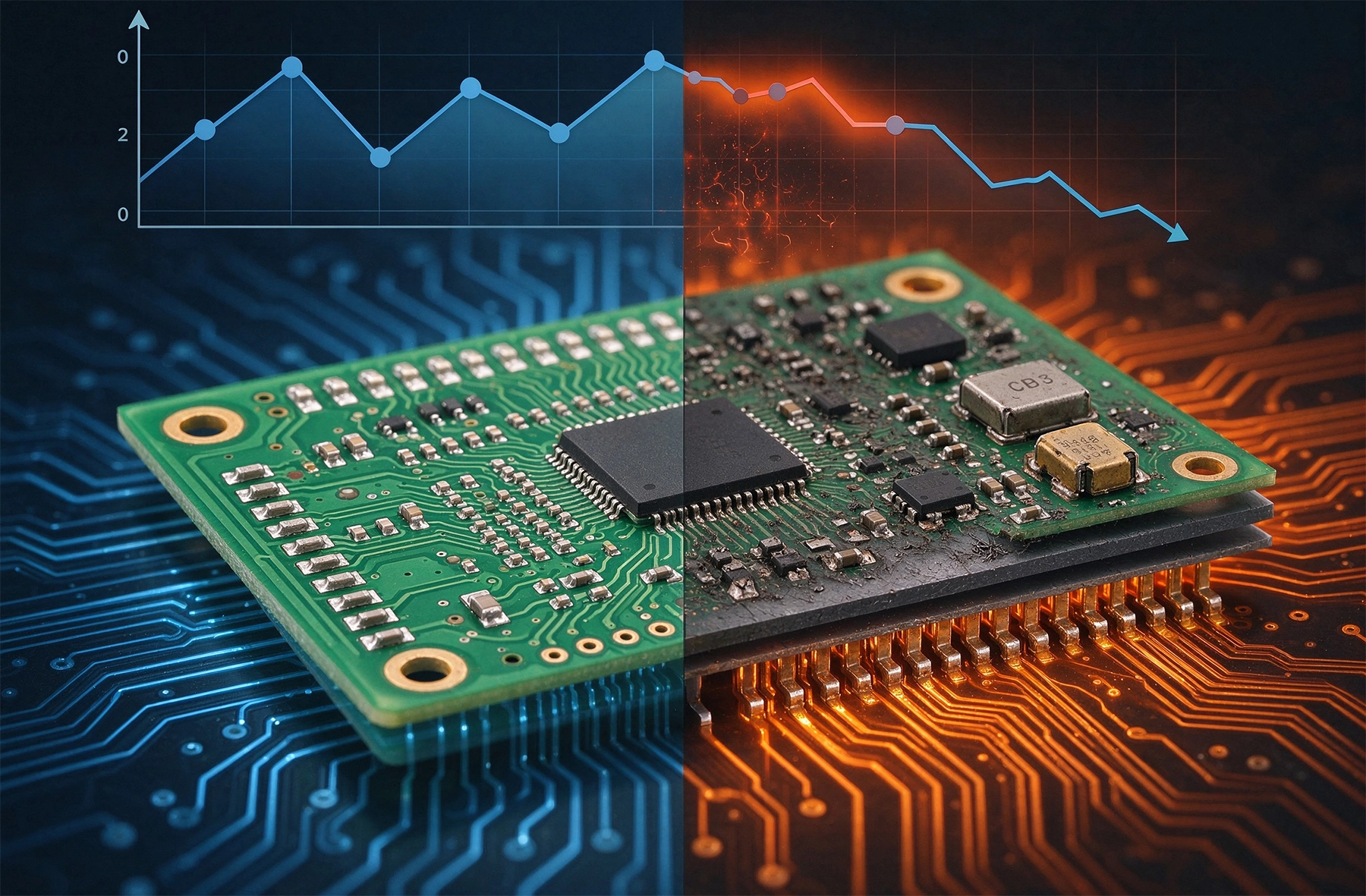
The biggest way cheap PCB vendors cut costs to offer below-market pricing is by using off-spec, expired, or counterfeit materials that are not qualified for production use. Every material input in the Pcb Manufacturing process has a significant impact on long-term reliability, and cutting corners on these materials creates hidden defects that only reveal themselves months or years after the product is deployed in the field.
Low-quality dielectric material is the most common material compromise. Reputable vendors use name-brand, high-Tg FR-4 material with consistent dielectric thickness and impedance properties sourced from certified suppliers. Cheap vendors use off-brand, low-grade FR-4 that often has thickness tolerance of ±20 percent, high moisture absorption, and a glass transition temperature 20 to 30°C lower than specified. This material delaminates easily during Reflow Soldering, has inconsistent impedance that degrades Signal Integrity, and absorbs moisture over time leading to corrosion of copper traces and solder joint failure. I once received a batch of boards from a cheap vendor where the FR-4 material was so low quality that 15 percent of the boards had visible delamination between layers after just one reflow cycle, requiring the entire batch to be scrapped.
Counterfeit or substandard components are another common cost-cutting tactic used by cheap assembly vendors. Reputable vendors source components directly from authorized distributors, with full traceability for every part. Cheap vendors source components from grey market brokers, where parts are often recycled from e-waste, remarked to look like higher-spec components, or simply counterfeit. These counterfeit parts have failure rates 10 to 20 times higher than genuine components, and they often fail prematurely after 6 to 12 months of field operation. In our smart lock disaster, 12 percent of the units failed after 8 months in the field because the cheap vendor had used counterfeit flash memory chips that degraded over time and lost their programming, rendering the locks completely unresponsive. Replacing those units in customer homes cost us more than $120,000 alone.
Expired or low-grade Solder Paste and surface finishes are another common material compromise. Cheap vendors often use expired Solder Paste that has been sitting on the shelf for months past its use-by date, leading to cold solder joints, solder ball defects, and poor joint reliability over time. They may also use cheap Immersion Silver or tin surface finishes that are prone to whisker growth, which causes short circuits months or years after assembly. These defects are almost impossible to detect during incoming inspection, and they only reveal themselves after the product has been in use for an extended period, leading to costly field failures and warranty claims.
The second major way cheap PCB vendors cut costs is by skipping critical Quality Control steps and using outdated, uncalibrated manufacturing equipment that produces inconsistent results. Reputable vendors invest heavily in Quality Control processes and equipment, spending 10 to 15 percent of their revenue on inspection and testing to ensure defect-free products. Cheap vendors eliminate these steps to reduce their operating costs, passing the risk of defects directly to the customer.
Automated optical inspection and X-ray Inspection are two of the most critical quality control steps in Pcb Assembly, catching 90 percent of assembly defects before they leave the factory. Reputable vendors run every board through Aoi after solder paste printing, after component placement, and after reflow, plus X-ray Inspection for all BGA and fine-pitch QFN components. Cheap vendors skip these inspection steps entirely, or run them only on a small sample of boards, allowing obvious defects like missing components, tombstoned passives, and BGA solder bridges to slip through to the customer. The cost of fixing these defects at the customer's facility is 10 times higher than fixing them on the factory floor, and if the defects make it all the way to end customers, the cost jumps to 100 times higher.
Incoming material inspection is another step that cheap vendors almost always skip. Reputable vendors inspect every component reel upon receipt, verifying part numbers, date codes, and authenticity, and running electrical sample testing on critical components. Cheap vendors skip this step entirely, assembling whatever components arrive from their suppliers without verification, which means counterfeit or out-of-spec components are assembled directly onto boards with no check. This is how counterfeit flash chips ended up in our smart lock production run: the vendor never bothered to inspect the components they received from their grey market supplier.
Impedance testing and material lot verification for high-speed and high-frequency boards are also commonly skipped by cheap vendors. If your design requires Controlled Impedance of 50 ohms ±10 percent, a reputable vendor will test impedance coupons from every panel to verify compliance. A cheap vendor will skip this testing entirely, assuming the material meets specification, which can lead to Signal Integrity issues that cause intermittent failures that are extremely difficult to diagnose after assembly. We once had a batch of high-speed camera interface boards from a cheap vendor where the impedance was 20 percent out of spec, leading to 40 percent of the units failing to achieve the required data rate, requiring a complete redesign of the interface and a 3-month delay to the product launch.
Cheap vendors also use outdated, uncalibrated manufacturing equipment that produces inconsistent results. A 10-year-old SMT placement machine with worn-out nozzles will have much higher placement error rates than a new machine with regular calibration. An uncalibrated reflow oven will have temperature profiles that vary across the panel, leading to cold joints on some boards and burnt components on others. These process inconsistencies lead to higher defect rates and lower long-term reliability, even if the materials used are of acceptable quality.
The first hidden cost you will encounter when working with a cheap PCB vendor is the cost of reworking defective boards and scrapping entire batches that are too defective to repair. Reputable Pcb Assembly vendors typically achieve first-pass yield rates of 95 percent or higher, meaning only 5 percent of boards require minor rework before shipping. Cheap vendors often have first-pass yield rates of 70 to 85 percent, meaning 15 to 30 percent of boards are either scrapped entirely or require extensive rework to fix defects.
The cost of scrapping 20 percent of a 1,000 unit production run erases any upfront cost savings immediately. If you paid $5 per board for assembly from a cheap vendor instead of $7 from a reputable one, you saved $2,000 upfront. But if 200 boards are scrapped, you have to pay for another 200 boards to be built, costing you an extra $1,000, plus the cost of expedited shipping to get the replacement boards in time to meet your deadline, which can easily add another $500 to $1,000. By the time you add in the engineering time spent diagnosing the defects and coordinating the rework, you have already spent more than the $2,000 you saved upfront.
If the defects are not severe enough to require scrapping, you will have to spend hours of engineering and technician time reworking the boards yourself. A board with a missing component or a solder bridge might take 10 minutes to rework, but if 30 percent of a 1,000 unit run has defects, that adds up to 50 hours of technician time, costing thousands of dollars in labor. And even after rework, reworked boards have higher long-term failure rates than boards that were built correctly the first time, because the rework process can damage adjacent components or weaken solder joints.
Schedule delays are another major hidden cost of working with cheap vendors. Cheap vendors often overpromise lead times to win orders, then push your order back when they get higher-paying work from larger customers. A 2-week delay to a product launch can cost you 10 to 20 percent of your projected first-year revenue, especially if you miss a critical holiday selling window or a customer contract deadline. For startup companies, a 1-month delay to product launch can mean running out of funding before the product ever hits the market, which is an existential risk that no amount of upfront cost savings can justify. We once lost a $500,000 customer contract because a cheap vendor delivered our boards 3 weeks late, making us miss the customer's integration deadline. The $10,000 we saved on the assembly cost was nothing compared to the $500,000 in lost revenue.
The most expensive hidden cost of cheap Pcb Fabrication and assembly is the cost of field failures and warranty claims that arise months or years after the product has been shipped to customers. Defects that slip through the missing quality control steps at the cheap vendor's factory do not always reveal themselves during incoming inspection or Functional Testing. They often lie dormant for months, then cause failure after the product has been deployed in the field, where the cost of repair or replacement is exponentially higher.
For consumer products, the cost of replacing a failed unit in the field is typically 20 to 30 times the original cost of assembly. You have to pay for shipping the replacement unit to the customer, shipping the failed unit back for analysis, customer support labor to handle the complaint, and the cost of the replacement unit itself. If the failure is widespread enough to require a full product recall, the costs can be catastrophic, running into millions of dollars even for relatively low-volume products. In our smart lock incident, we had to replace 1,200 units in customer homes, at a total cost of $120,000, six times the $20,000 we saved by choosing the cheap vendor.
For industrial and commercial products, the costs can be even higher. If your PCB assembly fails in an industrial control system, the customer may face thousands of dollars per hour in downtime costs, which they may attempt to recover from you in liability claims. A single failure in a medical device can lead to patient harm and expensive product liability lawsuits that can put a small company out of business entirely. The liability risk alone makes choosing a cheap vendor for high-reliability applications a reckless decision that no responsible product manager should ever make.
Warranty reserves are another hidden cost. If your product has a 2-year warranty, you have to set aside a percentage of revenue to cover expected warranty claims. Products assembled by cheap vendors typically have 3 to 5 times higher warranty claim rates than products assembled by reputable vendors, which means you have to set aside 3 to 5 times more capital for warranty reserves, capital that could be used for Product Development or business growth instead of being tied up to cover expected failures.
The most difficult hidden cost to quantify, but often the most damaging in the long run, is the reputational damage caused by poor quality products. If your product has a high failure rate, customers will leave negative reviews, warn other potential buyers away from your brand, and choose your competitors for future purchases. For consumer brands, online reviews make or break sales, and a wave of negative reviews about product reliability can sink a product line before it ever gains traction in the market.
For B2B companies that sell to other businesses, a reputation for poor quality can cost you major customer accounts and make it much harder to win new business. Business customers rely on their suppliers to deliver reliable products that keep their operations running, and they will quickly drop a supplier that delivers products with high failure rates. Rebuilding a damaged reputation takes years of consistent high-quality performance, and many small companies never recover from a major quality incident.
We experienced this firsthand with our smart lock product. After the field failures, our Amazon average rating dropped from 4.5 stars to 2.7 stars, and sales dropped by 70 percent almost overnight. It took us two years of releasing improved products and working to repair our reputation before sales returned to their previous levels. The lost revenue during those two years was far more than the direct cost of the product replacement program.
The only way to make a rational sourcing decision is to calculate the total cost of ownership over the full product lifecycle, not just compare the upfront per-unit price. The TCO formula includes:- Upfront fabrication and assembly cost- Expected rework and scrap cost- Expected schedule delay costs- Expected warranty and field failure costs- Expected reputational damage costs
When you run this calculation, you will almost always find that the slightly higher upfront cost of a reputable vendor is far cheaper than the low upfront cost of a cheap vendor once all the hidden costs are included. For example, a $7 per unit board from a reputable vendor with 98% first pass yield, 0.5% field failure rate, and on-time delivery guarantee will have a far lower TCO than a $5 per unit board from a cheap vendor with 80% first pass yield, 5% field failure rate, and 30% probability of delivery delay.
A good rule of thumb is that any quote that is 20 percent or more below the average of the other quotes you receive is almost certainly hiding cost-cutting measures that will lead to higher total costs over the product lifecycle. If a deal seems too good to be true, it almost always is.
Choosing a Pcb Fabrication and assembly vendor based solely on the lowest quoted price is a false economy that almost always ends up costing far more in the long run. The hidden costs of material compromises, skipped quality control, rework and scrap, schedule delays, field failures, and reputational damage add up to many times the initial upfront savings. For product teams that want to build reliable products, minimize long-term costs, and build a strong reputation with their customers, investing in a reputable, quality-focused PCB vendor is one of the highest ROI decisions you can make. The extra few dollars you pay per unit upfront will pay for itself many times over in avoided hidden costs and improved customer satisfaction over the product lifecycle.
Contact us to discuss your Pcb Fabrication And Assembly requirements and to explore how our rigorous quality control and transparent pricing model can help you minimize total cost of ownership for your electronic products.
How to Read a Quote for PCB Fabrication and Assembly ServicesOctober/27/2026
Common Defects in PCB Assembly and How Manufacturers Prevent ThemSeptember/18/2026

Prototyping vs. Production Assembly: Different Approaches for Different StagesSeptember/08/2026
Turnkey Assembly: How to Hand Off Your Project and Get Finished ProductsJuly/22/2026
Handling Mixed Technology: Integrating SMT, THT, and Odd-form ComponentsAugust/12/2026
PCB Fabrication and Assembly: A Step-by-Step Guide for BeginnersOctober/15/2026
SMT vs THT PCB Assembly in China: Which Technology is Right for Your Project?June/10/2026
Inspection Standards: IPC-A-610 and What it Means for Your Assembled BoardsAugust/03/2026